


Choosing Between BOPP Laminated And Standard Woven Bags depends on the product being packed, required protection, printing needs, filling weight, handling conditions, and total packaging cost. BOPP-laminated bags add a continuous film layer that improves moisture resistance, surface appearance, and print definition. Standard polypropylene woven bags provide a lower-cost structure with breathability and practical performance for many bulk materials.
The correct selection is not simply a choice between a premium bag and a basic bag. It requires comparing material construction, GSM, dimensions, load capacity, seam design, closure type, filling equipment, storage conditions, compliance requirements, and expected product loss. This guide also explains when the additional BOPP cost may reduce leakage, rejection, rework, spoilage, or secondary packaging expenses.
Different Woven Plastic Bags solve different packaging problems. A standard bag may be the correct option for a dry mineral product stored indoors, while a BOPP-laminated structure may be more suitable for a retail food product exposed to humidity and repeated handling. Evaluation should begin with the product’s physical properties rather than the bag’s appearance.
The most important criteria are protection, mechanical performance, printing, process compatibility, and total cost of ownership. Moisture-sensitive products may require laminated polypropylene bags for moisture resistance, an inner liner, or both. Heavy industrial materials may require higher GSM fabric, reinforced seams, and a closure compatible with automated filling and palletizing.
A buyer should also define measurable specifications before requesting quotations. These typically include bag dimensions in millimeters, fabric GSM, filling weight in kilograms, acceptable weight tolerance, top and bottom construction, print colors, UV requirements, liner thickness, and packaging quantity per bundle. Without these details, suppliers may quote different constructions that cannot be compared fairly.
BOPP-laminated bags use woven polypropylene fabric combined with a biaxially oriented polypropylene film. The film is applied to one side of the woven substrate and creates a more continuous outer surface for graphics and additional protection. Standard woven bags use woven PP tapes and fabric without the added BOPP film, allowing more air exchange through the fabric structure.
BOPP laminated bags add a continuous protective film for moisture resistance, cleaner high-resolution printing, and stronger branding, while standard woven PP bags offer lower cost, higher breathability, and practical heavy-duty performance. The better choice depends on whether protection and presentation justify the added material and conversion cost.
| Comparison factor | BOPP laminated bags | Standard PP woven bags |
|---|---|---|
| Main construction | Woven PP fabric with BOPP film | Woven PP fabric without BOPP film |
| Moisture protection | Higher surface protection; liner may still be required | Limited unless coated or internally lined |
| Breathability | Lower | Higher |
| Print surface | Suitable for detailed, multi-color graphics | Suitable for simpler flexographic printing |
| Surface appearance | Glossy or matte film finish | Textured woven finish |
| Typical cost position | Higher unit price | Lower unit price |
| Common filling weights | Approximately 10–50 kg, depending on design | Approximately 10–50 kg, with larger industrial formats available |
| Typical products | Rice, flour, pet food, animal feed, retail agriculture products | Fertilizer, cement, sand, grains, chemicals, construction materials |
| Reuse and recycling | Polypropylene-based; construction affects recycling process | Primarily PP structure and generally simpler to process |
| Main design concern | Film adhesion, creasing, moisture performance | Fabric strength, seam strength, and dust control |
The table provides a starting point, but the final performance depends on fabric GSM, tape denier, coating weight, film thickness, seam construction, and filling method. A 75 GSM standard bag and a 110 GSM standard bag should not be treated as equivalent products. Likewise, BOPP film thickness and lamination adhesion must be confirmed rather than assumed from the term “laminated.”
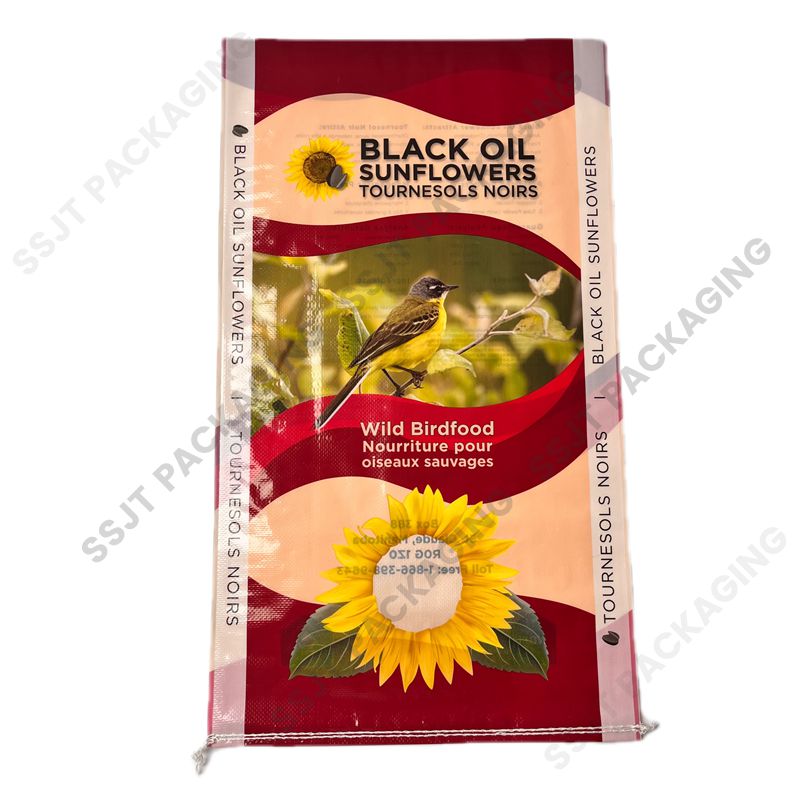
BOPP laminated bags are often selected when the package must protect the product while also functioning as a retail-facing presentation surface. The BOPP film can provide a smoother substrate for graphics than uncoated woven fabric. This supports sharper logos, product photographs, nutritional panels, handling instructions, and color blocks.
The film does not make the bag completely waterproof. Moisture can still enter through the mouth, seams, needle holes, damaged areas, or poorly sealed liners. For hygroscopic products such as flour, starch, sugar, powdered feed, and some fertilizers, buyers should specify whether the application needs exterior lamination, an inner PE liner, heat sealing, or a combined structure.
For branded product packaging, the printing specification should include artwork dimensions, color references, ink type, print registration tolerance, barcode readability, and acceptable color variation. Buyers may request a printed proof and a production sample before mass production. A signed artwork approval should be linked to the purchase order to prevent disputes over colors, text, and layout.
BOPP laminated bags are generally suitable for rice, flour, pet food, animal feed, seeds, charcoal, and selected agricultural products. They can also be used for construction materials when the package requires printed product information, but heavy abrasive contents may require stronger fabric, reinforced bottoms, or a more durable film specification.
Standard woven bags consist of woven polypropylene tapes converted into a sack through cutting, sewing, printing, and finishing. Their open woven structure provides a degree of breathability that can be useful for products that must release residual heat or air after filling. They are commonly used for fertilizer, grains, potatoes, feed ingredients, cement, sand, wall putty, and other bulk materials.
The absence of BOPP film usually reduces material and conversion cost. It also makes the surface more textured, which can be acceptable when packaging is used mainly for transport, warehouse storage, or industrial distribution. If dust containment or moisture protection is important, a coated surface, inner liner, or heat-sealed insert may be necessary.
Standard woven bags are often suitable when the product is dry, the storage environment is controlled, and the package does not require a retail-grade printed surface. They can also be preferable for agricultural products that need ventilation during short storage or transport. However, breathability should not be confused with protection from condensation or rain.
For cement, sand, gravel, fertilizer, and other heavy industrial materials, the bag specification should focus on load capacity, seam strength, puncture resistance, and handling equipment. A common design may use a plain or printed woven body with a stitched top and bottom. A block-bottom or valve construction may be selected when automatic filling and stable pallet stacking are required.
The bag’s performance starts with the PP tape and fabric design. Relevant specifications include tape width, tape thickness, warp and weft density, fabric GSM, coating weight, and the ratio of virgin to recycled material where applicable. These parameters affect tensile strength, elongation, tear resistance, puncture behavior, and finished bag weight.
For a 25 kg or 50 kg bag, the correct GSM depends on product density, filling speed, drop height, pallet pattern, transport distance, and handling frequency. A bag used for fertilizer may face different chemical and outdoor exposure than a bag used for rice. Buyers should request test results for the finished bag, not only raw fabric data.
Mechanical checks may include fabric tensile testing, seam strength, drop testing, top-to-bottom load testing, and visual inspection for broken tapes or incomplete stitching. A written specification should define the test method, sample quantity, acceptance limit, and retest procedure. For critical packaging, testing should be performed on samples taken from the actual production lot.
UV stabilization is important when filled bags remain outdoors or under warehouse skylights. A UV additive can slow sunlight-related degradation, but the required level depends on exposure duration, geographic conditions, bag color, and stacking arrangement. Buyers should state the intended outdoor storage period, such as 30, 60, or 90 days, rather than simply requesting “UV-resistant woven bags.”
Moisture protection should be specified according to the product’s sensitivity and the actual exposure risk. BOPP lamination can reduce direct surface wetting, but it does not replace a sealed closure when the product must be protected from humidity for an extended period. An inner liner may provide a more effective internal barrier for powders and fine granules.
The decision should consider four possible moisture pathways: the bag wall, top opening, bottom seam, and handling damage. A laminated body with an open stitched mouth may still allow moisture entry during rain. A liner that is not properly fitted may wrinkle near the seal and create leakage or filling problems.
Useful specification questions include:
For food and agricultural products, buyers should also review odor, ink migration, film composition, and applicable food-contact requirements in the destination market. A supplier should provide the relevant declarations, material information, and test documentation before production approval.
Custom printed woven bags can support product differentiation, but printing requirements should be matched to the bag structure. Standard woven fabric is suitable for basic text, logos, handling symbols, and limited-color designs. BOPP film generally provides a smoother surface for detailed graphics, photographic images, small text, and large color areas.
A buyer comparing custom printed woven bags should assess more than the number of print colors. The purchase specification should identify print method, ink suitability, print coverage, registration tolerance, artwork format, proofing process, and acceptable color deviation. The supplier should confirm whether the printing occurs before or after lamination and how the process affects rub resistance.
BOPP laminated bags are usually the better choice for branding and detailed printing because the film creates a flatter, more uniform surface. They are especially appropriate for rice, flour, pet food, seed, and animal-feed brands sold through retail or distributor channels. Standard woven bags remain suitable when the package is primarily functional and the printed information is limited to identification or regulatory text.
Branding must not compromise handling performance. Large printed areas, dark colors, or film finishes can affect heat absorption and surface scuff visibility. Buyers should also verify barcode scanning after printing, particularly when bags are processed through warehouse or retail systems.
A supplier quotation should be based on a complete data sheet. The following checklist reduces comparison errors between BOPP laminated and standard woven bags:
| Specification | Information to define |
|---|---|
| Bag dimensions | Length, width, gusset, flap, and dimensional tolerance in millimeters |
| Fabric construction | GSM, tape denier or thickness, warp density, and weft density |
| Filling weight | Nominal kilograms, permitted weight range, and product bulk density |
| Product type | Powder, granule, seed, feed, cement, chemical, or other material |
| Liner choice | No liner, loose liner, attached liner, PE thickness, and sealing method |
| Closure | Stitched mouth, heat seal, valve, drawstring, or block-bottom valve |
| Bottom design | Single fold, double fold, stitched, pasted, or reinforced construction |
| Printing | Colors, coverage, artwork, proof approval, and ink requirements |
| UV stabilization | Required exposure period and storage conditions |
| Palletizing | Bag orientation, stack height, pallet dimensions, and stretch-wrap needs |
| Testing | Tensile, seam, drop, leak, moisture, print rub, and dimensional checks |
| Packaging for shipment | Bundle quantity, carton or bale format, container loading plan |
The filling machine must be considered before selecting the bag. Valve bags and block-bottom bags may improve filling speed and pallet stability, while open-mouth sacks may be more appropriate for sewing lines. A bag that performs well in manual packing may create stoppages on an automated line if its dimensions, mouth opening, or valve design are inconsistent.
Unit price alone does not determine the lowest packaging cost. A useful calculation includes the bag price, freight, filling-line efficiency, pallet utilization, leakage, rejected units, secondary packaging, product loss, and disposal or recycling costs. The result is the cost per accepted and delivered unit, not merely the cost per empty bag.
For preliminary budgeting, a buyer can use a relative index. If a standard woven bag is assigned a cost index of 100, a comparable BOPP-laminated bag may be budgeted at approximately 115–145 before exact specifications, order quantity, printing coverage, liner selection, and freight are confirmed. This is a planning range rather than a supplier quotation, and the actual difference can be narrower or wider.
A simple TCO model is:
Total packaging cost = bag cost + filling losses + rejected bags + product loss + rework + secondary protection + transport-related damage
For example, suppose a business fills 100,000 bags per month. If a standard bag costs $0.18 and a BOPP bag costs $0.24, the monthly bag-cost difference is $6,000. If the BOPP structure reduces product loss and rework by $7,500 per month, the estimated net benefit is $1,500 before other savings. If no measurable reduction occurs, the lower-cost standard structure may remain the better choice.
The calculation should use verified plant data. Record leakage incidents, rejected bags, damaged pallets, customer complaints, moisture-related claims, and filling-line stoppages for at least one production cycle. A controlled trial of 5,000–10,000 bags can provide more useful evidence than a general assumption about premium packaging.
Quality compliance should be assessed through documents and physical samples. For food-contact products, request material declarations and applicable migration or compliance documentation for the PP fabric, BOPP film, ink, coating, and liner. The required documents depend on the destination country, product category, and intended contact conditions.
The purchase order should define acceptance criteria for dimensions, bag weight, print placement, color variation, film adhesion, seam integrity, and visible defects. Film adhesion can be assessed through an agreed peel or tape test, while print durability may be checked through rub testing under specified dry and wet conditions. The method and acceptance limit should be agreed before production.
A supplier evaluation should include:
Shengshijintang describes its operations as covering PP woven bags, BOPP laminated bags, block-bottom valve bags, FIBC big bags, and PP woven fabric rolls. Its published company information states that it has operated since 1983, has three factories with annual production capacity of 30,000 metric tons, supplies more than 300 million bags annually to approximately 30 countries, and operates facilities covering 80,000 square meters, including a 50,000-square-meter clean production workshop. These figures can help buyers assess scale, but procurement decisions should still be based on product-specific samples, test records, and confirmed production schedules.
Delivery risk often comes from incomplete specifications, late artwork approval, raw-material changes, production congestion, or unclear inspection timing. A buyer should separate the lead time for artwork, sampling, raw-material preparation, production, inspection, container loading, and international transport. These stages should be recorded in the purchase contract rather than represented by one broad delivery estimate.
For repeat orders, maintain an approved technical file containing the bag drawing, artwork, material construction, closure design, liner specification, test limits, and packing method. Any change to resin source, film thickness, ink, adhesive, fabric GSM, or sewing pattern should require written approval. This prevents an apparently similar reorder from producing a different package.
A practical delivery-control plan may include a pre-production meeting, digital artwork approval, first-article sample, mid-production inspection, and final random inspection before shipment. Buyers handling seasonal goods such as fertilizer, seed, rice, or animal feed should place orders early enough to include at least one corrective-production window. The precise schedule depends on order volume and factory loading, so it should be confirmed for every project.
| Application | Usually suitable structure | Main reason |
|---|---|---|
| Rice and grains | BOPP laminated or lined woven bag | Branding, moisture control, and retail appearance |
| Flour, starch, and sugar | BOPP laminated with suitable liner or sealed construction | Powder protection and controlled moisture exposure |
| Animal feed and pet food | BOPP laminated, lined, or standard woven depending on channel | Retail graphics versus cost-focused bulk distribution |
| Fertilizer | Standard woven, coated, laminated, or lined | Required protection depends on moisture sensitivity and chemical formulation |
| Cement and wall putty | Standard woven or valve/block-bottom construction | Mechanical load, filling speed, and stacking stability |
| Sand, gravel, and construction materials | Heavy-duty standard woven | Lower cost and resistance to routine handling |
| Chemicals | Coated, laminated, lined, or specialized woven construction | Chemical compatibility and leakage control |
| Seeds and agricultural products | BOPP laminated or standard breathable woven | Depends on humidity, shelf life, and sales channel |
| Charcoal | BOPP laminated or coated woven | Surface cleanliness, printed presentation, and moisture control |
| Outdoor industrial materials | UV-stabilized woven construction | Resistance to sunlight exposure during storage |
No single bag structure is best for every product. The same fertilizer may require a standard woven bag for short indoor storage but a laminated and lined bag for humid coastal distribution. Likewise, rice sold in retail stores may justify BOPP printing, while rice transported in bulk to a processing facility may prioritize cost and ventilation.
| If your priority is… | Consider… | Because… |
|---|---|---|
| Lowest initial packaging cost | Standard PP woven bag | It uses fewer material layers and supports functional bulk packaging |
| Moisture-sensitive powder protection | BOPP laminated bag with liner or sealed closure | The combined structure limits moisture pathways more effectively |
| Detailed retail branding | BOPP laminated bag | The film offers a smoother printing surface |
| Breathability for agricultural goods | Standard woven bag | The unlaminated fabric allows greater air exchange |
| Automated valve filling | Block-bottom valve bag | The design supports controlled filling and stable stacking |
| Outdoor storage | UV-stabilized construction | UV additives and suitable fabric design reduce sunlight-related degradation |
| Heavy abrasive materials | Higher-GSM standard woven bag | Mechanical specifications can be prioritized over surface appearance |
| Reduced product rejection | Laminated or lined construction after trial validation | Improved protection may reduce damage and customer complaints |
| Small-business packaging | Standard woven for bulk, BOPP for retail | The sales channel determines whether graphics justify added cost |
| Long-term supply consistency | Supplier with documented QC and production capacity | Process control and traceability reduce variation between orders |
Choosing Between BOPP Laminated And Standard Woven Bags should be based on product sensitivity, handling conditions, printing requirements, filling equipment, and total cost of ownership. Standard woven bags are generally appropriate for cost-focused bulk packaging of cement, fertilizer, grains, sand, and other dry industrial materials. BOPP laminated bags are more suitable when moisture resistance, detailed printing, surface appearance, and retail presentation affect product value or rejection risk.
Before purchasing, define the bag dimensions, GSM, filling weight, liner choice, closure type, UV exposure, print specification, and testing requirements. Then request samples and compare actual performance through filling trials, drop tests, seam checks, moisture assessments, and transport simulations. For larger programs, calculate the cost per accepted delivered unit rather than comparing empty-bag prices alone.
Woven Plastic Bags from a supplier such as Shengshijintang can be evaluated through its product range, production capacity, factory processes, quality records, and ability to provide customized constructions. The final choice should be approved only after the proposed bag meets the product’s protection requirements, the filling line operates without excessive stoppages, and the documented total cost supports the intended application.
Previous: Benefits of Woven Plastic Bags For Industrial Packaging
Next: Why Agriculture Brands Prefer BOPP Laminated Woven Bags
Related Products
If you need some advice, quotation or sample information, please fill in and get in touch with us.


